Article
Deep Dive into V8 and V8 Isolates: The Engine and the Sandbox (Part 1)
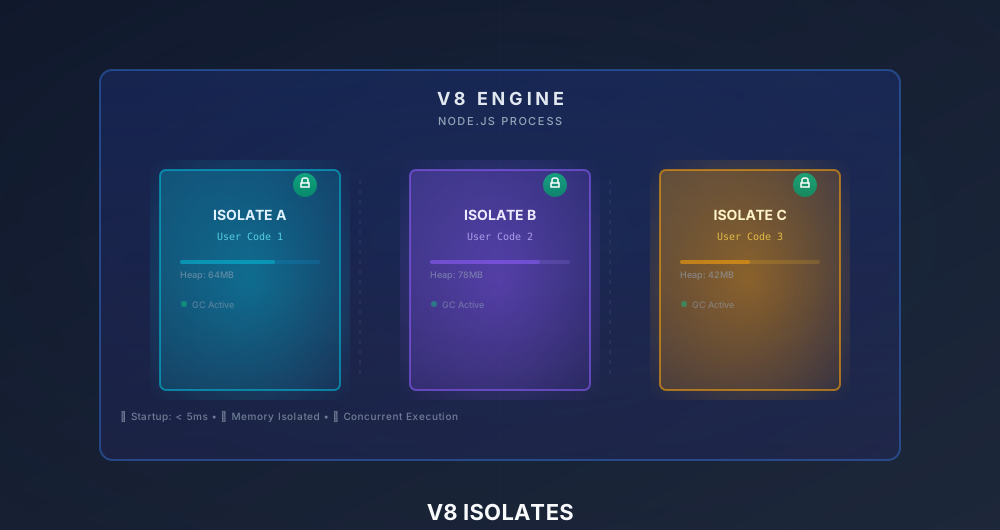
Part 1: Deep Dive into V8 and V8 Isolates - The Engine and the Sandbox
Imagine you need to run code you don't fully trust - maybe it's user-submitted plugins, third-party extensions, or dynamically generated scripts. What's stopping that code from reading your environment variables, accessing your file system, or consuming all your server's resources?
This is the central challenge of modern computing: How do you run untrusted code safely?
You could use Docker containers, but their 5-second "cold start" would kill your user experience. Virtual Machines are even slower. You need something that can create a perfectly secure sandbox in less than 5 milliseconds.
Enter the V8 Isolate - the battle-tested technology that powers Google Chrome and makes it possible to run untrusted code at massive scale, securely. This is the same technology behind platforms like Cloudflare Workers and Deno Deploy.
This guide explains what V8 Isolates are, how they work, and how you can use them to build secure, high-performance applications.
🏎️ What is V8? The Engine That Powers JavaScript
Before we talk about isolates, let's understand V8 itself.
V8 is Google's open-source JavaScript and WebAssembly engine, written in C++. Think of it as the high-performance engine inside cars like Google Chrome and Node.js. Its job is to take human-readable JavaScript and compile it into lightning-fast machine code for your computer's processor.
Every console.log("hello") you write goes through V8.
V8 is everywhere:
- Google Chrome (browser)
- Node.js (server)
- Deno (modern runtime)
- Cloudflare Workers (edge computing)

How V8 Achieves Speed: JIT Compilation
V8's secret weapon is Just-In-Time (JIT) Compilation - a clever two-stage process:
Stage 1: Ignition (The Fast Starter)
- When your code first runs, V8's interpreter Ignition executes it immediately
- This gives you instant startup - no waiting for compilation
- Think of it as a speed reader that gets the job done quickly
Stage 2: Turbofan (The Optimizer)
- Ignition watches your code as it runs
- If it sees a function being called repeatedly (a "hot function"), it calls in the specialist: Turbofan
- Turbofan is V8's optimizing compiler - it takes that hot code and recompiles it into hyper-optimized machine code
- The result? Lightning-fast execution for frequently-used code
This two-stage approach gives you the best of both worlds: fast startup and maximum sustained performance.

🚪 What is a V8 Isolate? The "Sealed Room" Analogy
Now we get to the most important concept. If the V8 Engine is the motor, the V8 Isolate is the perfectly sealed, soundproof room in which that motor runs.
An Isolate is an isolated, independent instance of the V8 engine.
Think of it literally as a sealed room:
- It has its own private memory (its own heap)
- It has its own garbage collector (its own cleaning crew)
- It has zero access to the outside world
- The walls are soundproof and airtight
A person in one room cannot see, hear, or interact with a person in another room. If a program in one isolate crashes, it only affects that one "room" - the rest of your application keeps running perfectly.
You Use This Every Day: Chrome Tabs
You already use this technology daily. Every tab in Chrome runs in its own isolate.
When you have Gmail open in one tab and your bank in another, Gmail's JavaScript cannot access your banking tab's memory. If a malicious website crashes in tab 3, it doesn't take down Gmail and your bank.
This is V8 Isolates in action.

What Makes Each Isolate "Sealed"?
Each isolate has its own:
-
Dedicated Heap Memory ⭐ Most Important
- Each isolate has its own private memory space
- Code in Isolate A cannot read or write memory from Isolate B
- This is the foundation of security
-
Independent Garbage Collector
- Each isolate cleans up its own memory
- Memory cleanup in one isolate doesn't slow down others
-
Separate Global Scope
- Each isolate has its own
globalobject - Built-in objects like
Math,JSONare separate instances
- Each isolate has its own
⚡ Why Isolates Changed Everything: The Performance Revolution
For years, we used Virtual Machines and Docker containers to isolate code. But they're heavy:
| Technology | Startup Time | Memory Overhead | Good For |
|---|---|---|---|
| Virtual Machines | Seconds | Very Heavy | Full OS isolation |
| Docker Containers | 500ms - 10s | Medium | Microservices |
| V8 Isolates | < 5ms | Very Light | Code execution |
V8 Isolates are micro-sandboxes:
- No operating system
- No filesystem
- No networking
- No environment variables
Just pure JavaScript execution.
This breakthrough enabled the serverless revolution. Platforms like Cloudflare Workers can run code from thousands of customers on the same machine, all completely isolated, with zero cold start. They spin up a new isolate for each request in under 5 milliseconds.

🧪 What Happens Inside an Isolate?
Inside an isolate, you get a clean, empty JavaScript world:
let a = 10;
let b = 20;
a + b; // Works fine!But no access to:
- ❌
fs(file system) - ❌
process(environment variables, exit) - ❌
require(importing modules) - ❌ Any Node.js internals
Unless you explicitly expose them using a secure bridge.
🛠️ Practical Guide: Building Sandboxes with isolated-vm
While V8 is a C++ library, the isolated-vm library for Node.js gives you direct access to this power.
First, install it:
npm install isolated-vmThe fundamental security rule is simple: The isolate is a jail with zero access to your host system by default.
Example 1: Your First Sandbox with Time and Memory Limits
This example shows how to create a sandbox with strict resource limits. The code inside cannot run forever or consume unlimited memory.
const ivm = require('isolated-vm');
async function runUntrustedScript(code) {
// 1. Create a new Isolate with resource limits
const isolate = new ivm.Isolate({
memoryLimit: 128, // Max RAM consumption: 128MB
});
const context = await isolate.createContext();
// 2. Compile the script (LLM-generated or user-submitted code)
const script = await isolate.compileScript(code);
try {
console.log('--- Running Script in Sandbox ---');
// 3. Execute with a 1-second timeout
const result = await script.run(context, { timeout: 1000 });
console.log('Result:', result);
} catch (e) {
console.error('Execution Failed:', e.message);
} finally {
isolate.dispose(); // Always clean up the isolate
}
}
// Case 1: Safe code
const safeCode = `10 + 20;`;
// Case 2: Time-out code (infinite loop)
const maliciousCode = `while(true) {}`;
// Case 3: Forbidden access attempt
const securityRiskCode = `process.env.SECRET_API_KEY;`;
runUntrustedScript(safeCode);
// Output: Result: 30
runUntrustedScript(maliciousCode);
// Output: Execution Failed: Error: Script execution timed out.
runUntrustedScript(securityRiskCode);
// Output: Execution Failed: ReferenceError: process is not defined What just happened?
- The infinite loop was killed after 1 second ✅
- The attempt to access
process.envfailed becauseprocessdoesn't exist in the isolate ✅ - Your secrets are safe ✅
🔔 The Challenge: Making Isolates Useful
Okay, our isolate is perfectly secure. But it's too secure. It's a jail cell with nothing inside. How can the code do anything useful if it can't call a database or an API?
The Solution: The "Bank Teller Window" Pattern
Think of it like a bank:
- Your Code (The Vault): Holds all your secrets - API keys, database passwords
- The Isolate (The Lobby): Where untrusted code runs
- The Bridge (The Teller Window): A secure pass-through that takes requests but never exposes the vault
The untrusted code can "ring the bell" (call a function), and your secure code handles it behind the scenes, passing back only the result.

Example 2: The "Bank Teller" in Action
Let's build a secure database proxy. The untrusted code can query the database, but it never sees your connection string.
const ivm = require('isolated-vm');
// --- HOST PROCESS (SECURE) ---
// This function runs on the secure host - secrets are protected here
function secureDbQuery(sql) {
const MY_DB_PASSWORD = 'super-secret-password-123';
console.log(`[🔐 Vault] Running query with password: ${sql}`);
// Real database query happens here with your credentials
return new ivm.ExternalCopy({ rows: [{ id: 1, name: "Alice" }], count: 1 }).copyInto();
}
async function runWithDatabaseAccess() {
const isolate = new ivm.Isolate({ memoryLimit: 128 });
const context = await isolate.createContext();
// 1. Inject the secure query function
const queryRef = new ivm.Reference(secureDbQuery);
await context.global.set('_queryHost', queryRef);
// 2. Create a simple wrapper inside the isolate
// This hides the complex applySync API and makes the function easy to call
await context.eval(`
globalThis.db = {
query: function(sql) {
return _queryHost.applySync(undefined, [sql], { arguments: { copy: true } });
}
};
`);
// 3. Run the untrusted code
const script = await isolate.compileScript(`
// This code can call db.query, but it NEVER sees your password
const data = db.query("SELECT * FROM users WHERE active = true");
'Found ' + data.count + ' active users.';
`);
const result = await script.run(context, { timeout: 1000 });
console.log('📤 Result returned to caller:', result);
isolate.dispose();
}
// Call the function
runWithDatabaseAccess();
/*
Output:
[🔐 Vault] Running query with password: SELECT * FROM users WHERE active = true
📤 Result returned to caller: Found 1 active users.
*/The Magic:
- The untrusted code called
db.query()✅ - Your database password was never exposed to the isolate ✅
- The actual query ran in your secure Node.js process ✅
- Only the result was passed back ✅
This is the Authenticated Object Pattern - the foundation of secure sandboxing.
🛡️ Security Rules: What to NEVER Expose
The security of this model depends entirely on what you don't inject. Never expose:
- 🚫
process- No access toenvorexit - 🚫
fs- No file system access - 🚫
net,http- No raw network access (always proxy it) - 🚫
eval,new Function- No dynamic code generation - 🚫
require- No importing arbitrary modules
Only expose controlled, purpose-built functions through the bridge.
🎯 Summary: The Three Key Concepts
- V8 is the engine that compiles JavaScript into fast machine code
- V8 Isolates are sealed rooms - independent instances with their own memory and zero cross-contamination
- The Authenticated Object Pattern lets you give isolates controlled capabilities without exposing secrets
This combination gives you:
- ⚡ Speed: Sub-5ms startup (vs. 5+ seconds for containers)
- 🔒 Security: True memory isolation
- 🎛️ Control: You decide exactly what the code can access
🚀 What's Next: Real-World Applications
V8 Isolates are not just theoretical - they're the foundation of:
- Cloudflare Workers (running millions of functions at the edge)
- Deno Deploy (secure TypeScript execution)
- Browser extensions (isolated plugin environments)
- Serverless platforms (fast, secure function execution)
In Part 2 of this series, we'll explore how modern platforms use this exact architecture to run untrusted code at massive scale. We'll dive into advanced patterns like the "Code Mode" approach, where systems can execute dynamically generated code inside these secure sandboxes - including how AI agents can safely run their own code without exposing your infrastructure.
Now that you understand the fundamentals of V8 Isolates, you're ready to explore how they're revolutionizing everything from edge computing to AI agent architectures.