Article
The Temporal Blindness Problem: Designing Time-Aware AI Architectures
As software engineers, we are comfortable with timestamps. Every database row has created_at. Every log line has a time. Every HTTP request carries a header telling you when.
LLMs have none of these things.
A Large Language Model is a stateless text predictor. Within its context window, a token generated five milliseconds ago holds the exact same mathematical weight as a token from a source document written five days ago. There is no internal clock. No System.currentTimeMillis(). No event loop ticking in the background. The model reads a flat sequence of text and predicts the next token - that's it.
In production environments - clinical scheduling systems, multi-day support pipelines, voice agents handling live phone calls - this temporal blindness creates critical vulnerabilities that pure prompt engineering cannot solve.
In this deep dive, we will break down why time is fundamentally invisible to LLMs, the middleware patterns engineers use to inject it, and how OpenAI, Anthropic, and Google are architecturally solving this problem at the platform level.
⏳ The Core Structural Failures
Production failures caused by temporal blindness typically fall into two categories.
1. Memory Staleness (The Conflicting Context Matrix)
This occurs when an agent executes actions based on outdated information because it cannot weigh data based on recency.
Consider a clinic appointment system handling multi-channel inputs - asynchronous WhatsApp messages and live phone calls. On Monday, a patient texts to reschedule their Friday appointment. On Thursday, they text to cancel it entirely. On Friday at 1:45 PM, their symptoms spike, and they call the clinic's voice agent asking if they can still see the doctor at 2:00 PM.
If the voice agent runs a standard semantic vector search for "Friday appointment status," the database retrieves both the Monday modification and the Thursday cancellation with nearly identical cosine similarity scores. Lacking a built-in mechanism for recency bias, the agent reads a flat, contradictory list of facts. It is highly likely to tell a panicked patient, "I see you canceled your appointment yesterday," completely ignoring the live context of the ongoing call.

The problem is clear: cosine similarity is not temporal awareness. The vector database returns semantically relevant results, but it has no concept of which one is current.
2. Tool Over-reliance (Redundant Polling)
Because a stateless model cannot evaluate how much time has passed since its last data-fetching operation, it will redundantly invoke identical tools during a single conversation loop. An agent might query an internal inventory database or availability calendar three times within a ten-second window, driving up system latency and inference costs. Without an internal clock, the model has no way to say, "I just checked this 5 seconds ago, the data is still fresh."
🛠️ Middleware Solutions: Injecting Recency Bias
Before the introduction of native model architectures for time, engineers relied entirely on retrieval middleware to force a sense of time onto stateless models. These are the patterns you can implement today.
Exponential Time Decay (ETD)
This approach modifies the vector retrieval layer. Instead of feeding raw semantic similarity scores directly into the LLM orchestrator, a decaying multiplier is applied based on the delta of elapsed time since the memory node was recorded.
The math relies on a standard decay curve:
Sfinal = Scosine × e-λΔt
- Scosine: The raw semantic similarity score returned by the vector database.
- Δt: The time elapsed since the event occurred.
- λ (Lambda): The decay rate constant, tuned specifically to the ingestion channel.
The key insight is that λ is not a universal constant. It must be tuned based on how time behaves across different communication mediums:
| Channel Type | Channel | λ Setting | Decay Behavior |
|---|---|---|---|
| Asynchronous | WhatsApp, SMS, Email | Low (~0.01) | Memories fade slowly over days. A text from 6 hours ago remains highly relevant. |
| Synchronous | LiveKit Audio, WebRTC, Phone | High (~0.5) | Memories decay in minutes. Statements made yesterday are aggressively down-ranked so they don't hallucinate over live conversation context. |
Let's revisit our clinic example with ETD applied:

Now the Monday modification is almost invisible (0.14), and the live call context dominates (0.87). The agent responds to the current situation.
Interceptor Patterns (Just-In-Time Time Injection)
A secondary middleware pattern utilizes an orchestration wrapper that sits between the LLM and the application layer. Every time the agent initiates a tool request or transitions to a new step in a state machine, the orchestrator intercepts the payload and appends a precise duration statement:
System Note: 14 minutes have elapsed since the user last provided their insurance ID.
This injects temporal awareness on a just-in-time basis without cluttering the long-term context window. It's the middleware equivalent of whispering the time into the model's ear right before it makes a decision.
📝 Text-Based Agents: Hierarchical Memory and Batch Consolidation
For text-based, long-horizon tasks - managing multi-day customer support pipelines or tracking asynchronous healthcare records - temporal awareness is handled by isolating state across hierarchical memory layers.
Modern agent memory frameworks like Mem0 distinguish between three layers:

The critical pattern here: background worker loops handle memory staleness via separate maintenance routines. Rather than forcing the primary model to track timelines mid-session, these workers evaluate conversation logs, resolve contradictory instructions, delete redundant nodes, and promote high-utility context to a consolidated long-term store.
This turns memory management into a point-in-time versioned file system - similar to how databases use Write-Ahead Logs (WAL). The agent can cleanly track progress over multi-day operations without bloating its context window.
Mem0, one of the leading open-source memory frameworks, benchmarks this approach against the LoCoMo (Long Conversation Memory) benchmark, which evaluates agents across single-hop recall, temporal reasoning, and multi-hop inference across hundreds of conversation turns.
🎙️ Audio-Native Agents: Continuous Streaming and Millisecond Boundaries
For audio-native environments - voice agents operating over WebRTC or telephony - time cannot be batched or evaluated after the fact. It must be managed continuously.
Audio-native architectures process sound directly as continuous multi-modal frames rather than relying on a separate speech-to-text transcription step. In this environment, temporal awareness is deeply tied to conversational mechanics like Voice Activity Detection (VAD) and interruptibility.
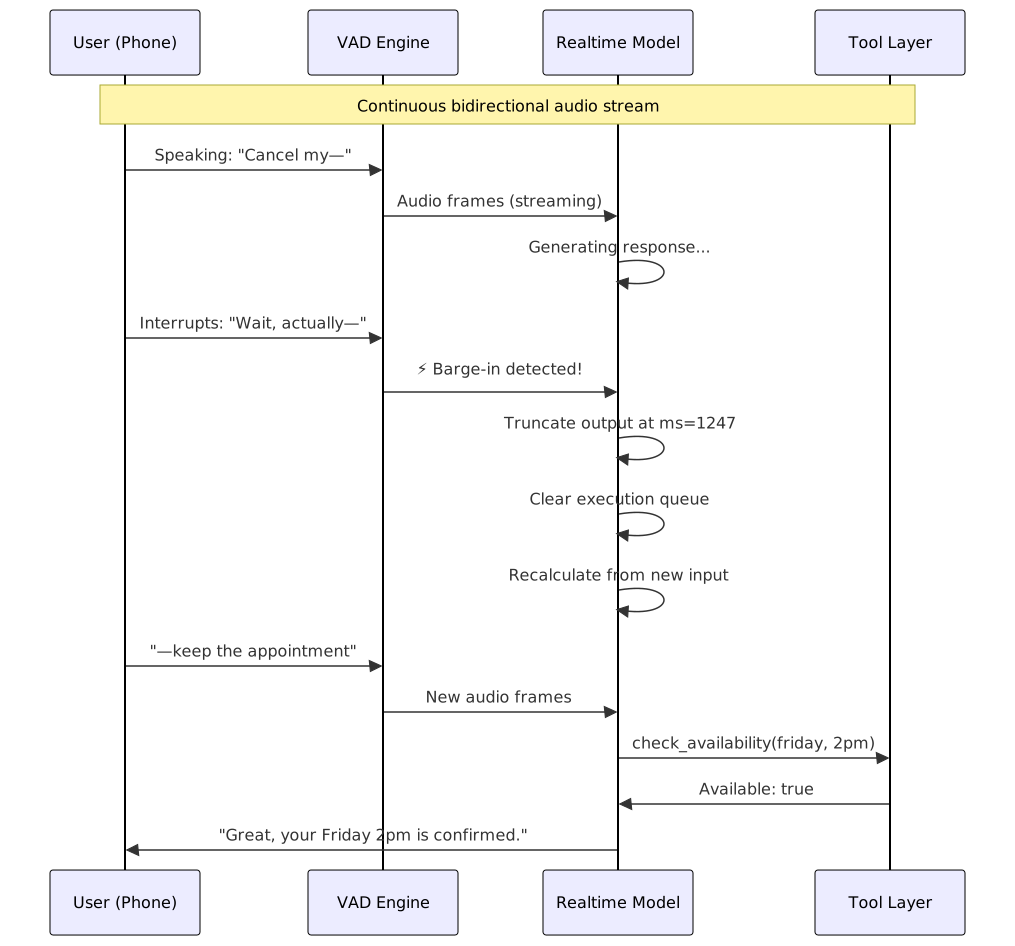
The system tracks token boundaries in real time. If a user interrupts the agent mid-sentence, the runtime orchestrator immediately truncates the model's output stream, records the exact millisecond mark where the interruption occurred, clears the remaining execution queue, and recalculates the next response based on the new audio input. Time awareness here is expressed as a fast, low-latency execution loop where the context window constantly adapts to live streaming data.
This is fundamentally different from text-based temporal awareness. Text agents deal with time on the scale of hours and days ("when was this message sent?"). Audio agents deal with time on the scale of milliseconds ("the user interrupted at exactly this frame"). Both are temporal problems, but they require completely different engineering solutions.
🏗️ How the Big Labs Are Engineering Time
Major AI research organizations have developed explicit architectural solutions to handle temporal coordination. Each takes a fundamentally different approach.
OpenAI: Realtime API and Agentic Tool Constraints
OpenAI handles the temporal demands of synchronous audio through its Realtime API (currently at model version gpt-realtime-2.1). By moving away from cascading text pipelines - separate components for transcription, text inference, and speech synthesis - to a unified speech-to-speech model, the system achieves sub-300ms first-token latency.
Because real-time voice interactions leave little room for error, the system relies on structured tool-calling behaviors to keep pace with conversational time. OpenAI's prompting architectures explicitly partition tools by their structural risk and temporal urgency:
| Tool Category | Execution Pattern | Example |
|---|---|---|
| Read-Only / Low-Risk | Eager execution during stream. No confirmation needed. | check_availability(), lookup_patient() |
| Write / High-Impact | Halt stream → Summarize action → Demand verbal confirmation → Execute | cancel_appointment(), process_refund() |
This is a temporal design pattern: the model is trained to understand that irreversible actions require a deliberate pause in the real-time loop - a human-mandated latency injection.
Additionally, OpenAI's Responses API and Agents SDK introduce tracing patterns that monitor agent-turn durations over long-horizon tasks, tracking operations that span from 30 minutes to multiple hours across parallel sub-agents.
Anthropic: Managed Agents and "Claude Dreaming"
Anthropic approaches temporal persistence through an isolated memory layout in its Managed Agents framework. When a session is initiated, the platform mounts a dedicated memory store as a sandboxed directory inside the agent's runtime environment (located under the /memories path). The agent interacts with this directory using file-system tools, and every modification generates an immutable, versioned history with a 30-day retention trail.
To resolve the problem of memory fragmentation and staleness without expanding active context windows, Anthropic relies on an off-session background optimization process called Claude Dreaming (introduced May 2026).

During a "Dreaming" session, a separate background loop collects logs from completed interactions - including task outcomes, failed tool calls, and retrieved entries. The model processes this history asynchronously between user interactions, identifying systemic contradictions, pruning outdated variables, and consolidating fragmented files into a clean baseline store. This ensures that when the next active session starts, the agent opens a fresh, structured timeline without needing real-time memory cleanup mid-session.
Early enterprise testing (e.g., Harvey, a legal-AI firm) reported up to 6x improvement in task completion rates after implementing Dreaming, as agents could remember specific tool workarounds and quirks that previously caused repetitive failures.
The key architectural insight: Dreaming treats downtime as a resource for temporal maintenance, not dead time. It's analogous to how biological REM sleep consolidates daily experiences into long-term memory.
Google DeepMind: Gemini Live API and Functional Execution
Google Cloud leverages the large native context windows of the Gemini family to maintain long-horizon temporal consistency during continuous live streams. The Gemini Live API allows applications to stream bidirectional text, audio, and video concurrently over WebSockets.
To prevent conversational loops from degrading over extended runtimes, DeepMind's architecture employs a technique called prompt chaining via functional execution. Instead of supplying the live session with a massive, unchanging list of instructions that can confuse the model as the interaction proceeds over time, the system uses a control loop:

The model is given a streamlined initial prompt and an explicit instruction-fetching tool. As tasks are completed or time milestones are crossed, the model queries the tool to retrieve its next contextual step, dynamically updating its focus based on the current state of the live stream. This prevents the "instruction decay" that occurs when a long prompt competes with accumulated conversation context.
📐 Choosing the Right Pattern
These aren't competing solutions. They solve temporal blindness at different layers:
| Layer | Pattern | Timescale | Best For |
|---|---|---|---|
| Retrieval | Exponential Time Decay (ETD) | Hours → Days | Any RAG-based agent with timestamped data |
| Orchestration | Interceptor / Time Injection | Seconds → Minutes | State machine agents with multi-step workflows |
| Memory | Hierarchical + Consolidation (Dreaming) | Days → Weeks | Long-running managed agents with persistent state |
| Streaming | VAD + Barge-in + Prompt Chaining | Milliseconds | Real-time voice and multimodal live agents |
The takeaway for engineers: until models possess a native internal clock, temporal awareness is not a model problem - it's an infrastructure problem. It is solved not by the model itself, but by the harness we build around it.
📚 References & Further Reading
- OpenAI: Realtime API Documentation - Architecture of speech-to-speech streaming, tool calling, and the
gpt-realtime-2.1model family. - OpenAI Cookbook: Temporal Agents with Knowledge Graphs - Hands-on guide for building temporally-aware knowledge graphs with multi-hop retrieval.
- Anthropic: Claude Managed Agents & Dreaming - Sandboxed memory directory mounts, session consolidation, and the Dreaming pipeline.
- Google Cloud: Gemini Live API Reference - Bidirectional audio/video streaming, function calling, and prompt chaining patterns.
- Mem0: AI Agent Memory Architecture - Hierarchical extraction, graph-based memory, and LoCoMo benchmark evaluation.