Article
The Agent Harness: Same Brain, Different Game
We love arguing about AI models.
Every time a new frontier model drops, whether it's GPT-5.4, Claude 4.7 Opus, or Gemini 3.1 Pro, the internet immediately lights up with takes about which one is the "smartest." We obsess over reasoning benchmarks, context window sizes, and response speeds. And sure, the foundational model matters. But here's the thing nobody talks about at dinner parties:
The exact same model can be brilliant in one product and utterly useless in another.
Take Claude 4.6 Sonnet. It powers Cursor, GitHub Copilot, open-source tools like Roo Code, and Anthropic's own Claude Code. It's the exact same underlying brain. Yet, they provide wildly different experiences. One feels like a mind reader that writes perfect code. Another feels like a confident intern who keeps breaking your build. Why?
The answer is the Agent Harness - and understanding it will fundamentally change how you think about the AI tools you use every day.
🧠 What Even is an Agent Harness?
Let's start simple.
An AI model is just a stateless text predictor. It has no memory between sessions. It can't read your local files. It can't run your code in a terminal. It can't recover from its own syntax mistakes. It's an incredibly powerful brain... floating in a jar.
The Agent Harness is the mechanical body you build around that brain.
Agent = Model + Harness
If an engineering component isn't the neural network itself, it belongs to the harness. The harness provides the model with everything it lacks to interact with the real world:
- 📁 A Workspace - A filesystem where it can read code, write files, and maintain state.
- 🔧 Tools - Access to APIs, terminals, linters, and databases.
- 🔄 Feedback Loops - Error interception, lint result parsing, and self-correction prompts.
- 🛡️ Guardrails - Rules that constrain what the agent can and cannot do.
- 🧠 Memory - Mechanisms to persist context across your multi-day coding tasks.
Think of it this way: the model provides the "what" and "why" (reasoning), while the harness provides the "how" and "where" (execution).

Without the harness, your frontier model is just a fancy chatbot. With the right harness, a moderately capable model can consistently outperform a frontier model that's poorly wrapped.
⏱️ The Timeline: How We Got to Harness Engineering
The realization that the wrapper matters more than the brain didn't happen overnight. The vocabulary around how we build with LLMs has rapidly evolved to reflect this architectural shift:
- August 2025: A consortium including OpenAI, Google, and Cursor releases the
AGENTS.mdspec, establishing an open standard for repository-scoped agent instructions. - December 2025: Andrej Karpathy coins the term "Context Engineering", highlighting the shift away from single-turn prompt engineering toward curating massive token contexts across sessions.
- Early February 2026: Mitchell Hashimoto (creator of Terraform) introduces the concept of "Harness Engineering", establishing the principle that when an agent makes a mistake, developers must build a structural solution to ensure it never happens again.
- February 11, 2026: OpenAI publishes its official framework on Harness Engineering, cementing the paradigm: "Humans steer. Agents execute."
- Late February 2026: Karpathy introduces the broader concept of "Agentic Engineering", solidifying the transition from writing raw application code to designing the systems that govern autonomous agents.
🧪 The Proof: One Model, Different Realities
This isn't theory. You can see the harness effect play out right now by comparing the top AI coding tools. Without getting bogged down in proprietary, ever-changing technical details, you can see how their distinct harness philosophies dictate their behavior:
The AI-Native IDE Harness (e.g., Cursor)
Cursor's harness is built around the concept of deep IDE integration and background validation. Rather than just taking the model's first answer, the IDE harness often acts as a safety net. It can run checks, look for type errors, and quietly ask the model to fix its own mistakes in the background before presenting the final code to you. The result is an experience that feels highly polished and integrated into your daily workflow.
The Open-Source Harness (e.g., Roo Code / Cline)
Open-source extensions often outperform official enterprise tools on specific benchmarks. Why? Because an open-source harness allows developers to heavily customize context retrieval and bypass rigid safety or formatting constraints. You have total freedom to tweak how the harness grabs context or handles errors, allowing the exact same underlying model to operate with fewer artificial limitations.
The Terminal-Native Harness (e.g., Claude Code)
A terminal-native agent uses a harness built around raw file system access and terminal commands. It has no visual IDE overhead. Its harness loops through terminal commands, reading outputs and iterating on errors autonomously. This makes it incredible for massive, multi-file refactoring across an entire repository, but requires more explicit prompting from the developer since the agent doesn't have the context of what file you currently have open on your screen.
The Ecosystem Harness (e.g., GitHub Copilot)
GitHub Copilot's harness operates in two distinct modes. Agent Mode works synchronously inside your IDE, it follows an iterative Plan → Act → Observe → Iterate loop, using terminal commands and file access to self-correct in real-time. But the more interesting mode is its Cloud Agent, which runs entirely asynchronously. You assign it a GitHub Issue, and it spins up a sandboxed container via GitHub Actions, writes code, runs tests, and opens a draft Pull Request for human review, all without a developer being at their desk. Its harness extends through the Model Context Protocol (MCP), allowing teams to connect internal tools directly into the agent's toolkit.

Same brain. Completely different products. The harness dictates the value.
🏗️ What Makes a Great Harness? The Three Layers
Building a production-grade harness isn't about bolting on as many tools as possible. A practice called Harness Engineering has emerged, operating across three distinct conceptual layers:
Layer 1: Constraints (Before Generation)
This layer reduces the agent's possible choices before it writes a single line of code. By explicitly defining what the agent cannot do, the harness forces the model to converge faster on the right answer. This includes your .cursorrules files, architectural linters, and team style guides.
Layer 2: Corrective Feedback (During Generation)
When the model generates code that fails compilation, the harness must intervene. A basic harness just throws the raw red text at the model. A sophisticated harness parses the error and prompts the agent with specific guidance. The best harnesses actively strip out eslint-disable comments if the AI tries to sneak them in, forcing it to actually fix the bug rather than ignore it.
Layer 3: Enforcement Gates (After Generation)
The final layer is the absolute gatekeeper. All linter rules configured as hard errors. "Staleness gates" block the AI from importing outdated libraries it memorized from its training data. Nothing merges until the harness says so.
🪄 The "Less is More" Principle
Here is the most counter-intuitive lesson in harness engineering: Adding more tools usually makes the agent dumber.
You'd think an agent with 20 specialized tools (one for schema lookups, one for git, one for API formatting) would be incredibly capable. But Vercel proved otherwise. They spent months building a complex text-to-SQL agent with a massive toolset. It worked okay, but it was fragile.
So they did something radical: they deleted 80% of the tools. They stripped the agent down to a single capability: executing arbitrary bash commands (grep, cat, ls).
The result was staggering:
| Metric | Old Architecture (Complex Tools) | Filesystem Agent (Raw Bash) |
|---|---|---|
| Success Rate | 80% | 100% |
| Execution Time | 274.8s | 77.4s (3.5× faster) |
| Token Usage | ~102k tokens | ~61k tokens (37% fewer) |
| Steps Taken | ~12 steps | ~7 steps (42% fewer) |
Every specialized tool is a choice you are making on behalf of the model, which constrains its reasoning. When Vercel stopped holding the model's hand and just gave it a filesystem, the model figured it out faster and better.
(Caveat: This only works if your codebase is well-documented. If your data layer is a mess, giving an AI raw file access will just result in faster bad queries.)
🔌 MCP: The Harness's Tool Layer
You might wonder where MCP (Model Context Protocol) fits in all of this. The answer is simple: MCP is the tool layer of the harness.
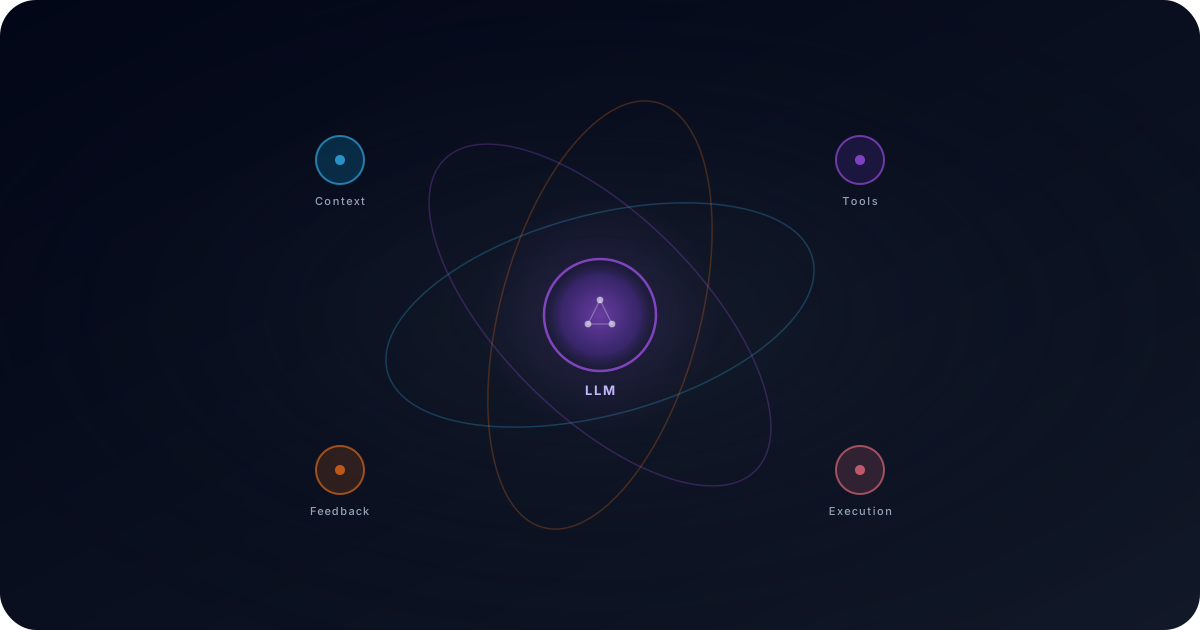
Remember the "Tools" component in our harness diagram? MCP is how that component actually works under the hood. It's the standardized protocol that lets a harness discover and invoke external tools, whether that's reading a Jira ticket, querying a database, or triggering a deployment pipeline.
Before MCP, every harness had to write custom API connectors for every tool integration. If you used Cursor, Copilot, and Claude Code, you needed three separate Slack integrations, three separate database connectors, and so on. MCP collapsed that M × N problem into M + N: write one MCP server for your tool, and every harness can use it.
This is directly relevant to harness quality. A harness with rich MCP integrations gives the model access to more context and more capabilities, making the same model dramatically more effective in that particular environment.
📊 The Benchmark Evidence
If you're still not convinced the harness matters more than the model, the data is clear.
On SWE-bench, the industry-standard benchmark where AI agents solve real GitHub issues autonomously, the gap between the top frontier models is often just a few percentage points. But research comparing the same model under different harnesses has observed 15–22+ percentage point swings in performance. The harness is the dominant variable, not the model.
Similarly, on the Terminal Bench 2.0 Leaderboard, LangChain researchers demonstrated they could move an agent from the Top 30 all the way to the Top 5—purely by optimizing the harness, without changing the underlying model. That's how much juice can be squeezed out of harness engineering.
This has become such a recognized problem that the community created SWE-bench Pro, which uses a standardized harness to remove "scaffold engineering" as a variable. The goal is to isolate raw model capability, which tells you everything about how much the harness was inflating (or deflating) scores on the original benchmark.
The components that produce the biggest measurable gains in agent performance are:
- Battling Context Rot - techniques like "compaction" (summarizing older context) and tool offloading to prevent the model's reasoning from degrading as the context window fills up.
- Tool orchestration - how the agent discovers and invokes tools
- Context management - techniques for compacting and maintaining state across long sessions
- Error recovery & retry logic - intelligent handling of failures with structured re-prompts
- Multi-agent coordination - adding a dedicated code-review agent alongside the coding agent measurably improves resolution rates
🧑💻 The Bottom Line
For software engineers, the takeaway is clear:
- Stop obsessing over the latest model version. The model is a commodity engine. The harness is the car.
- Clean code is for AI now. Great harnesses rely on well-structured, well-named filesystems.
- Keep it simple. Model + filesystem + clear rules. Add complexity only when necessary.
- Evaluate tools by their harness, not their model. When choosing between AI coding tools, look at how they wrap the model, their context strategy, their feedback loops, their error recovery, not just which model they use.
The organizations and developers who win the AI coding era won't be the ones with the smartest models. They'll be the ones who build the most stable, secure, and frictionless harnesses.
📚 References & Further Reading
If you want to dive deeper into the architecture of autonomy and harness engineering, here are some excellent resources that informed this post:
- Vercel: We removed 80% of our agent's tools - A fascinating look at the "addition by subtraction" principle in harness engineering.
- LangChain: The Anatomy of an Agent Harness - A deep dive into the foundational components of reliable agents.
- Augment: Harness Engineering for AI Coding Agents - How to implement constraints that ship production-ready code.