Article
The P2P Paradox: Why You Need a Server to go Serverless
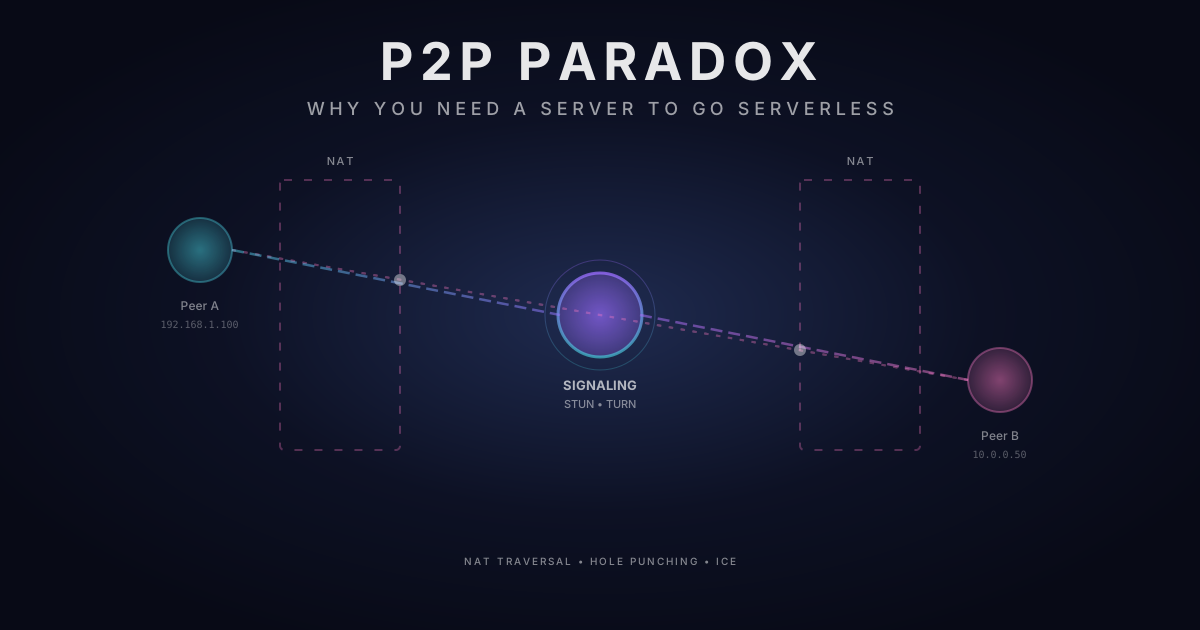
We love the idea of peer-to-peer (P2P) communication. It’s the magic behind instant, low-latency video calls in WebRTC and the decentralized promise of Web3. It's a world without middlemen, where your device talks directly to another.
Except for one massive, foundational problem.
How do you "directly" connect to a device that doesn't have a public address? If your laptop's IP is 192.168.1.100, and your friend's is 10.0.0.50, how do you find each other across the vast, public internet?
This is the P2P discovery problem. Before any "direct" connection can happen, you have to solve a complex puzzle of networking, security, and timing. This post explores that puzzle: the challenges of peer discovery and the ingenious solutions that make it work.
The Great Wall: What is NAT?
The root of our problem is Network Address Translation (NAT). It’s the technology in your home router that lets your 15 different devices (laptop, phone, smart TV) all share a single public IP address provided by your ISP.
NAT was a brilliant solution to the problem of IPv4 address exhaustion, and it adds a layer of security by hiding your internal network from the outside world.

But it also creates what I call the Three Layers of Ignorance for P2P:
- You don't know your own public address: Your laptop only knows its private IP (
192.168.1.100). It has no idea what public IP the router is showing to the world. - You don't know the peer's real address: Your peer has the same problem. They can't just tell you to connect to
192.168.1.50because that address is private to their network. - Routers block uninvited guests: Even if you did know your peer's public router IP, the router's firewall would drop your connection. It has no idea which of the 15 devices behind it should receive your packet, so it drops it for security.
A NAT only allows replies to connections that were started from inside the network. This breaks the P2P model entirely, which relies on peers being able to contact each other.
The Real Challenge: Not All NATs Are Created Equal
The problem gets worse. "NAT" isn't one single thing; it's a collection of behaviors. To build a system that works, you have to plan for the worst-case scenario.
1. The "Friendly" Cone NATs
Most NATs fall into this category (like Full Cone, Restricted Cone, or Port-Restricted Cone). Their behavior is predictable. When your device sends a packet out (e.g., to Server A), the NAT assigns it a public port, like 203.0.113.1:50000.
The key is that it reuses that same public port (:50000) for other destinations (like Server B or Peer C). This predictability is a "hole" we can exploit.

2. The "Problem Child" Symmetric NAT
This is the villain of our story. A Symmetric NAT is unpredictable and built for security. It doesn't just create one mapping; it creates a new, unique public port for every single destination.
Here’s why that breaks P2P:
- Your app connects to a setup server (Server A) to find its public IP. Your NAT assigns you
203.0.113.1:50000. - You tell your friend (Peer B), "Great! Connect to me at
203.0.113.1:50000." - Now, you try to send a packet to Peer B. Your Symmetric NAT sees this is a new destination and assigns you a brand new port:
203.0.113.1:50001. - Your friend sends packets to
:50000(which is now invalid or only for Server A), while you're sending from:50001.
Connection fails. You can't predict the port, and the port you discover isn't the one you'll use. This type is common in corporate networks and, critically, most 4G/5G mobile networks.

The Solution: A Toolkit for Punching Holes
Because of these challenges, we can't just "connect." We need a coordinated strategy. This is where ICE (Interactive Connectivity Establishment) comes in-it's WebRTC's complete playbook for finding and connecting peers.
ICE uses a few key tools to solve the discovery problem.
Step 1: The Signaling Server Paradox
Here's the central irony of P2P: to establish a decentralized connection, you must first use a centralized server.
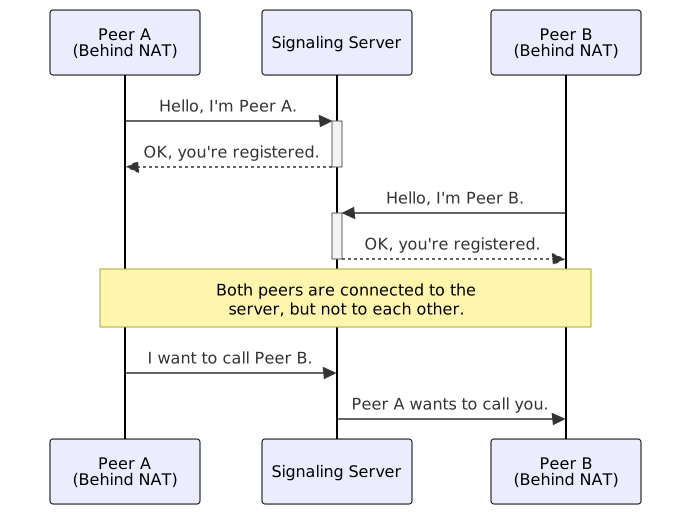
This is the Signaling Server. It's the one piece of the puzzle that isn't P2P. Its job is not to relay your video or data (that's expensive). Its job is to be a matchmaker.
Peers A and B both connect to the signaling server. They use it to trade messages and coordinate the connection, saying things like:
- "Hi, I'm Peer A, and I want to talk to Peer B."
- "Here are all the possible addresses I think I might be reachable at."
- "I'm now trying to connect to you, get ready!"
Step 2: Finding Your Address with STUN
To solve the "I don't know my public IP" problem, we use STUN (Session Traversal Utilities for NAT).
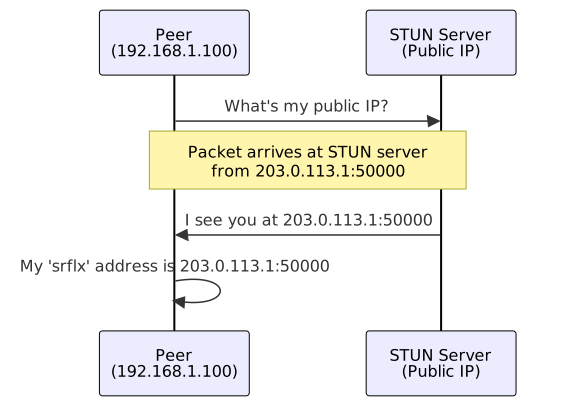
A STUN server is a very simple tool. You send it a packet, and it replies with one piece of information: "Here is the public IP and port I saw your packet come from."
This gives the peer its "server-reflexive" (srflx) address. The peer then passes this address to the other peer via the signaling server as a candidate address to try.
Step 3: The Clever Trick: UDP Hole Punching
For the "friendly" Cone NATs, we can use a trick called UDP Hole Punching.
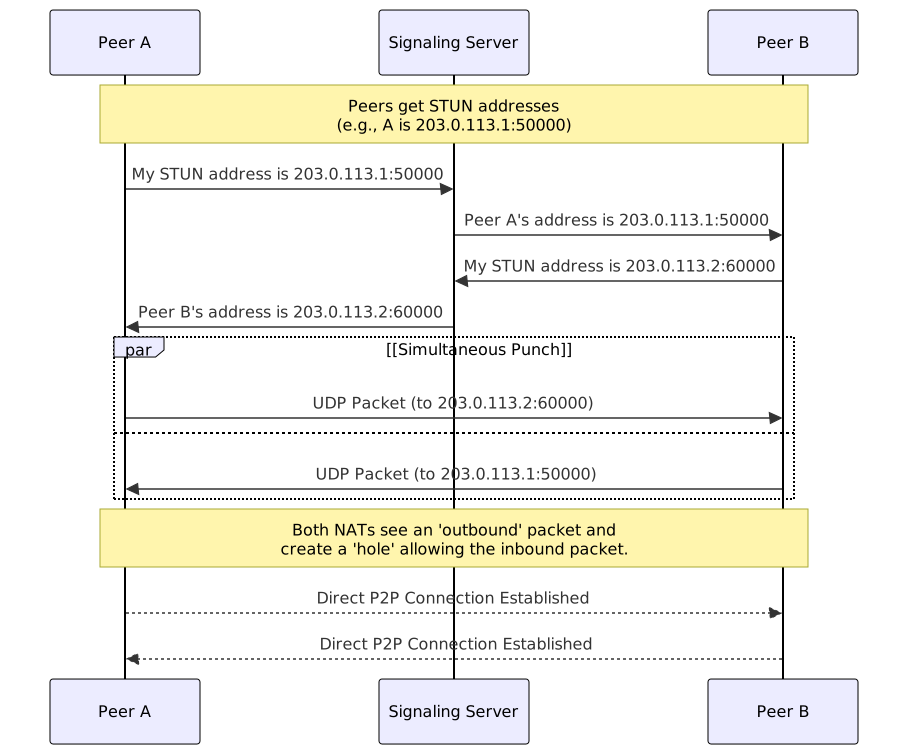
Now that both peers have (via the signaling server) a list of each other's potential public addresses (from STUN), they coordinate a "simultaneous send".
- Peer A sends a UDP packet to Peer B's STUN-discovered address.
- At the exact same time, Peer B sends a UDP packet to Peer A's STUN-discovered address.
From each NAT's perspective, this just looks like a normal outbound connection. This "punches a hole" in the NAT's state table, telling it, "I'm expecting a reply from that IP and port."
When Peer B's packet (which was sent simultaneously) arrives at Peer A's router, the router says, "Ah, this is the reply I was just told to expect!" and lets it through. A bidirectional connection is established.
Step 4: The Last Resort: TURN Relays
But what about Symmetric NAT? Hole punching fails because the ports are unpredictable.
This is where we admit (partial) defeat and use TURN (Traversal Using Relays around NAT). A TURN server is a powerful, and expensive, STUN server. Instead of just telling you your public IP, it acts as a full-blown mail-forwarding service.
You send your data to the TURN server, and the TURN server relays it to the other peer.
- The Good: It guarantees a connection will be established, even in the most restrictive mobile or corporate networks.
- The Bad: It's no longer true P2P. All your media flows through a central server, which adds latency and costs the service provider (e.g., Google, Twilio, or you) a lot of money in bandwidth.
Because 10-20% of users might be on a Symmetric NAT, services must pay for and provide TURN infrastructure for 100% of their users, just in case.

Why This Matters for WebRTC and Web3
This entire stack - Signaling, STUN, Hole Punching, and TURN, is the magic that makes WebRTC work. It's a complex, orchestrated dance that tries the cheapest, fastest path (direct P2P) first and gracefully falls back to the most expensive, slowest path (TURN relay) only when necessary.
For Web3, the challenge is identical. A decentralized storage network (like IPFS) or a P2P social app still needs its nodes to find each other. They face the exact same NATs, and while they may try to avoid "centralized" signaling servers by using Distributed Hash Tables (DHTs), the fundamental problem of hole-punching and Symmetric NATs remains.
The next time you join a video call instantly, remember the incredible (and invisible) work happening in the background just to solve that first, hardest problem: "Hello? Are you out there?"